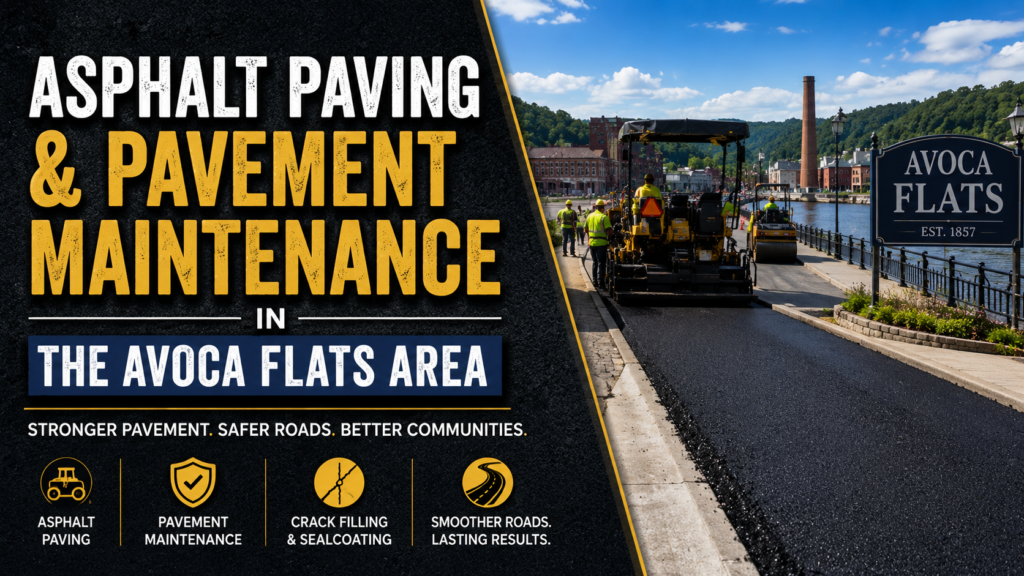
Nestled within the broader Avoca borough in Luzerne County, Pennsylvania, the Avoca Flats area represents one of the more level, accessible portions of this historically significant community. Like much of Avoca, this zone carries the quiet dignity of a neighborhood that grew from coal-era roots into a modern residential community one where older homes share streets with newer developments, and where the practical needs of residents intersect with the realities of aging infrastructure.
Flat terrain might seem to simplify paving work, but it actually introduces a unique challenge: drainage. Without natural slope to guide water away from surfaces, flat areas require careful grading and planned drainage solutions during asphalt installation. Understanding how pavement interacts with terrain is a foundational part of any professional Asphalt Contractor Avoca Flats approach in areas like Avoca Flats.
Asphalt as Infrastructure: More Than Just a Surface
When most residents think of asphalt, they think of the visible surface beneath their car tires the smooth, dark material of a driveway or road. But asphalt pavement is actually a layered system, and the visible surface is only one component of a carefully engineered structure.
A properly constructed asphalt pavement system consists of:
The Subgrade: This is the natural soil or earth beneath the pavement. Before any paving begins, the subgrade must be evaluated for stability. Soft, expansive, or moisture-prone soils can cause pavement to shift, crack, or settle unevenly over time. In Pennsylvania’s climate, subgrade quality is especially important because freeze-thaw cycles exert tremendous pressure on everything beneath the surface.
The Subbase: A layer of compacted aggregate typically crushed stone or gravel is placed on top of the subgrade to distribute load and assist with drainage. In flat areas like Avoca Flats, the subbase layer may be engineered to include specific drainage features that redirect water away from the pavement system.
The Base Course: A thicker layer of coarse asphalt mixture that provides the structural backbone of the pavement. This layer bears the weight of vehicles and transfers load evenly to the subbase.
The Surface Course: The top layer of fine-graded asphalt that provides a smooth, weather-resistant driving and walking surface. This is what drivers and pedestrians interact with directly.
Each layer must be properly compacted and bonded to the layer below it. Tack coats thin applications of asphalt emulsion are applied between layers to ensure adhesion. If any layer is improperly installed, the entire pavement system is compromised, regardless of how good the surface looks initially.
Flat Terrain and Drainage: A Critical Relationship
One of the most important principles in asphalt paving one that becomes especially significant in flatter terrain is that pavement must never allow water to pool. Standing water is one of the greatest enemies of asphalt, for several interconnected reasons:
Water Weakens the Subbase: When water infiltrates through surface cracks and saturates the aggregate base, the base loses its load-bearing capacity. Vehicle traffic on a saturated base causes the surface above to flex, crack, and eventually fail.
Freeze-Thaw Damage: In Pennsylvania’s winters, any water that has infiltrated below the pavement surface will freeze. Water expands approximately 9% when it freezes, exerting enormous upward pressure that heaves and cracks asphalt from below.
Surface Deterioration: Standing water softens the asphalt binder over time and accelerates oxidation, leading to surface raveling, cracking, and premature aging.
To address drainage challenges in flatter areas, professional asphalt contractors employ several strategies:
- Cross-Slope Grading: Even on flat terrain, pavements are graded with a slight cross-slope (typically 1-2%) to guide water toward the edges.
- Crown Profiles: Roads and wide driveways are often given a slight crown higher in the center, sloping toward both edges to shed water effectively.
- French Drains and Catch Basins: In areas where surface grading alone cannot solve drainage problems, subsurface drainage systems are installed.
- Permeable Pavement: In some cases, porous asphalt that allows water to drain through the surface is used in combination with a stone reservoir bed beneath.
Understanding and addressing drainage needs is a hallmark of quality paving work, particularly in neighborhoods like Avoca Flats where natural topographic drainage assistance is limited.
Common Asphalt Applications in Residential Flat Areas
Residential neighborhoods in flat terrain have several recurring asphalt needs, each with its own technical requirements:
Residential Driveways: Driveways are often the first asphalt surface a homeowner notices deteriorating, and also the one most directly under their control. A driveway in Avoca Flats may span anywhere from a short single-car apron to a long double-wide drive leading to a garage. Proper driveway installation includes attention to how the driveway connects to the public street (the apron), how water is directed away from the home’s foundation, and how edge restraints (curbing or edge borders) prevent the sides from breaking down.
Shared Access Lanes and Private Roads: In neighborhoods with close-set properties, private lanes and shared access paths are common. These surfaces are subject to frequent vehicle traffic and require durable construction with an appropriate base thickness.
Off-Street Parking Areas: Multi-unit residential properties and small commercial buildings often maintain off-street parking areas that require periodic maintenance, resurfacing, or complete reconstruction.
Pathway and Walkway Paving: Asphalt is sometimes used for pedestrian pathways, particularly in community green spaces and along property perimeters. It provides a more forgiving walking surface than concrete in freeze-thaw climates.
The Lifecycle of an Asphalt Surface
Understanding the typical lifecycle of asphalt helps property owners plan maintenance proactively rather than reactively. A well-constructed asphalt driveway or parking area will go through distinct phases:
Years 1–5 (New Pavement Phase): The surface is dark, dense, and in peak condition. During this phase, sealcoating applied at around year 2–3 can significantly extend overall pavement life by protecting the binder from UV oxidation and moisture.
Years 5–10 (Early Aging Phase): The surface begins to lighten in color as the asphalt binder oxidizes. Minor surface cracking may begin to appear, particularly along edges. This is the ideal time for crack sealing and a second round of sealcoating.
Years 10–20 (Maintenance Phase): Cracking becomes more visible and may begin to connect, forming networks. Pothole formation may begin in high-traffic areas or where base support has been compromised. Regular maintenance crack filling, patching, and sealcoating during this phase can extend pavement life significantly.
Years 20–30 (End of Life or Rehabilitation Phase): Without proper maintenance, pavement in this phase may require full replacement. With consistent maintenance, surfaces can remain serviceable. Options at this stage include full-depth reclamation, overlay (resurfacing), or complete removal and replacement.
The key insight is that preventive maintenance during earlier phases dramatically reduces the need for expensive rehabilitation later. Industry studies consistently show that a dollar spent on preventive maintenance during the early years of pavement life saves four to five dollars in future repair costs.
Sealcoating: The Most Impactful Preventive Maintenance Step
Among all the asphalt maintenance services available, sealcoating delivers the highest return on investment for residential and commercial property owners. Sealcoating applies a protective coating over the existing asphalt surface, filling minor surface voids and creating a barrier against the primary agents of asphalt degradation.
What sealcoating protects against:
- UV radiation: Sunlight oxidizes the asphalt binder, making the surface brittle and gray. Sealcoating reflects UV radiation and slows this process.
- Water infiltration: A sealed surface has fewer entry points for water, reducing the likelihood of base erosion and freeze-thaw damage.
- Motor oil and fuel spills: Petroleum-based chemicals dissolve asphalt binders. Sealcoating creates a resistant surface layer.
- Surface raveling: By filling minor surface voids, sealcoating binds loose aggregate and prevents progressive unraveling of the surface texture.
Sealcoating should be applied when the original asphalt has cured (typically 90 days after installation) and reapplied every 3–5 years depending on traffic and weather conditions. The surface should be clean, dry, and free of significant cracking before sealcoat application.
Environmental Considerations in Modern Asphalt Paving
Modern asphalt paving has made significant strides in sustainability. For communities like Avoca that are mindful of their environmental footprint, it is worth knowing that asphalt is one of the most recycled materials in the country.
Recycled Asphalt Pavement (RAP): When old asphalt is removed during repaving projects, it is not discarded. The milled material is collected and transported back to asphalt plants where it is blended with new aggregates and binder to produce recycled asphalt mixtures. The use of RAP reduces the demand for virgin materials and the energy required to produce new asphalt.
Warm Mix Asphalt Technologies: Producing asphalt at lower temperatures requires less fuel, generates fewer emissions, and allows for longer haul distances. Warm mix technologies also allow for paving at lower ambient temperatures, extending the paving season into cooler months.
Stormwater Management: Permeable asphalt systems contribute to sustainable stormwater management by reducing runoff and allowing groundwater recharge a benefit in flat, low-drainage areas.