Commercial Plots in Rawalpindi: A 2026 Investor’s Guide to Silver City
Buying commercial plots in Rawalpindi has become one of the smartest moves for investors who want steady rental yield and long-term capital growth. As the twin cities of Rawalpindi and Islamabad expand outward along the Chakri Road and Islamabad Expressway corridors, well-planned housing societies now offer serviced commercial land that rivals older market hubs. This guide breaks down what you actually get, how pricing works in 2026, and where the real upside sits.
Silver City sits at the centre of that story. It is a legally approved, master-planned community that has drawn buyers looking for transparent ownership and modern commercial zoning rather than the chaos of unplanned older bazaars.
Why commercial plots in Rawalpindi outperform in 2026
Commercial land behaves differently from residential land. A shop or plaza generates rental income from day one of occupancy, while a house mostly appreciates in value. That dual return — rent plus appreciation — is why serious investors weight their portfolio toward commercial holdings.
Three forces are driving demand this year:
- Population spillover: Islamabad’s core is saturated, pushing families and businesses toward the southern Rawalpindi belt.
- Infrastructure delivery: the Rawalpindi Ring Road and Expressway upgrades cut travel time to the airport and city centre.
- Formalisation: buyers now demand approved societies with clean documentation instead of file-trading in grey areas.
Pakistan’s real estate sector remains one of the largest stores of household wealth. The State Bank of Pakistan continues to track construction and real-estate financing as a key economic indicator, and demand for documented, bank-financeable property keeps rising.
What makes a commercial plot bankable
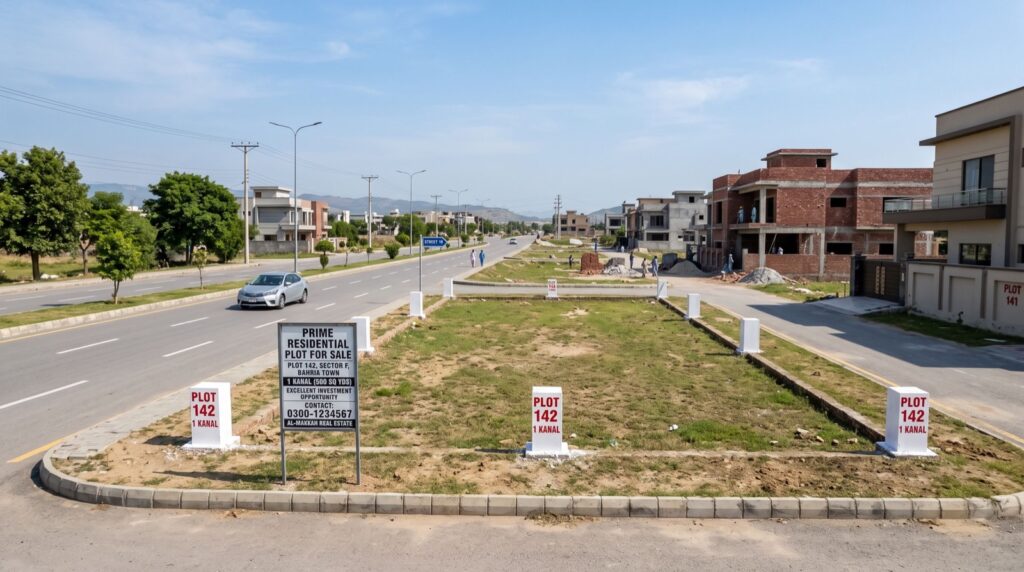
Not every commercial file is equal. The premium sits with plots that combine road frontage, corner position, and a location inside a high-footfall block. A 6 Marla Commercial Plot on an 80-foot main face, for example, commands stronger rent and resale interest than an interior plot of the same size because visibility drives commercial value.
Plot sizes and what they suit
Choosing the right size depends on your intended use — a single shop, a multi-storey plaza, or a mixed-use building. The table below compares typical commercial plot categories in a planned Rawalpindi society.
| Plot Size | Best Use | Typical Frontage | Investor Profile |
|---|---|---|---|
| 4 Marla | Single shop, café, small office | Standard face | Entry-level, quick rental |
| 6 Marla | Retail plaza, showroom | 80-foot main face | Yield-focused mid investor |
| 8 Marla+ | Multi-storey mixed-use | Corner / expressway face | High-capital, long hold |
For investors chasing vertical returns, high-density zoning matters most. Blocks designated for taller buildings, such as the High Rise Plots category, let owners build up rather than out, multiplying rentable floor area on the same footprint.
How to calculate realistic rental yield
Use a simple formula: annual rent divided by total plot-plus-construction cost, expressed as a percentage. In prime Rawalpindi society blocks, ground-floor retail commonly targets a gross yield in the mid-to-high single digits, with upper floors adding incremental income. Always model conservatively and factor a vacancy buffer.
- Estimate total acquisition cost (plot + transfer + construction).
- Research comparable rents in the same block.
- Divide annual rent by total cost for gross yield.
- Subtract maintenance and vacancy for net yield.
Which is the smarter buy for a first-time investor?
First-time buyers often hesitate between a small commercial shop and a larger plaza plot. The honest answer: start with a size you can hold without financial stress. A 4 to 6 Marla commercial plot on a main face gives you liquidity — it is easy to resell — while still producing rent once built. Overextending on an 8-Marla-plus plot before you have holding power is the most common beginner mistake.
Work with an experienced local team that knows block-by-block pricing, because on-ground knowledge beats generic online listings every time.
Due diligence checklist before you pay
- Verify society approval and NOC status with the relevant development authority.
- Confirm the plot number, dimensions, and block on the official master plan.
- Check that dues and development charges are clear.
- Get the transfer done through the society’s official office, never a side deal.
Financing and payment strategy for commercial buyers
Commercial land can be acquired through outright cash, structured instalments, or a mix of savings and financing. Each route has trade-offs, and the right choice depends on your holding power and cash flow. Cash buyers typically negotiate the sharpest discount and eliminate future instalment stress. Instalment buyers preserve liquidity but pay a higher total price over the plan’s life.
Consider a phased approach if you are building capital gradually. Many twin-cities investors book a plot on a down payment, hold through the development phase while the value appreciates, and then either construct or resell before the final instalments fall due. Executed carefully, this lets a modest upfront outlay control a larger asset.
Whatever you choose, keep three financial guardrails in place:
- Never overleverage: keep enough reserve to cover instalments even if your income dips.
- Model the exit: know your target resale price and holding period before you buy.
- Account for construction: a plot alone earns nothing — budget the build if you want rent.
Remember that a commercial plot’s value compounds fastest when the surrounding block matures. Buying early in a promising, approved block and holding through its development curve is a proven twin-cities strategy that rewards patient investors who did their homework.
Frequently Asked Questions
Are commercial plots in Rawalpindi a good investment in 2026?
Yes. With infrastructure like the Ring Road maturing and Islamabad’s core saturated, approved commercial plots in southern Rawalpindi offer both rental income and appreciation. The key is buying inside a legally approved society with clean documentation.
What is the difference between a commercial and a residential plot?
A commercial plot is zoned for shops, offices, plazas, and mixed-use buildings, so it can generate rental income immediately after construction. A residential plot is for homes and typically appreciates in value rather than producing steady rent.
How much frontage should a commercial plot have?
Frontage drives commercial value. A plot on an 80-foot main road or a corner position attracts far higher rent and resale demand than an interior plot of the same size, because visibility and footfall matter most to retail tenants.
Can I build a high-rise on a standard commercial plot?
Only if the block is zoned for high-density or high-rise construction. Always confirm the permitted floors and building bylaws for the specific block before purchasing, as zoning determines how much rentable area you can create.
Conclusion
The case for commercial plots in Rawalpindi in 2026 rests on three pillars: documented ownership, strong road frontage, and location inside a growing, approved society. Whether you start with a compact retail plot or scale into high-rise zoning, buy for frontage and legality first, and let appreciation follow. Do your due diligence, model your yield conservatively, and lean on knowledgeable local guidance. Ready to explore verified commercial options in a master-planned community? Start your search today and secure a plot that works for you for years to come.